
Timeline
January - March 2025
(12 weeks)
Role
UX Researcher
UX Designer
Team
Olivia Todd
Lydia Parker
Context
Students often find it difficult to balance academics, personal life and overall well-being
Many Humber Polytechnic students find it difficult to balance academics, personal life, and well-being, often unaware of the mental health resources available to them.
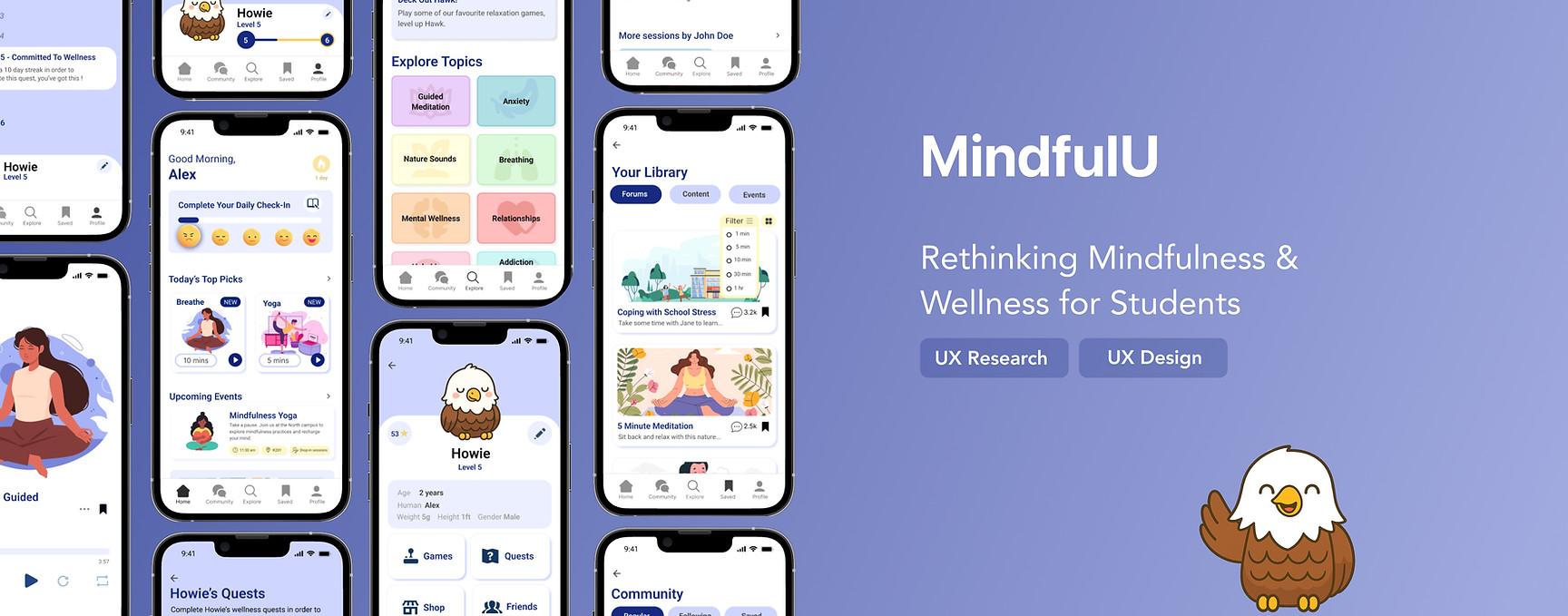
Partnering with the Centre for Innovation in Health & Wellness (CIHW), our team designed a digital tool to promote mindfulness and make campus wellness support more accessible to students.

How might we
make mindfulness more accessible and meaningful for the student community at Humber and Guelph-Humber?
Research
Key Research Questions:
-
Identify the key mental health challenges students currently face and how these affect their overall well-being.
-
Analyze the effectiveness of existing mindfulness and wellness apps in supporting students’ mental health needs.
-
Understand the coping strategies students use to manage stress and mental health challenges.
-
Explore opportunities to design a digital solution that promotes mindfulness and enhances student well-being.
Competitor Analysis
Existing mindfulness apps focus on content, not connection
To better understand the strengths and weaknesses of existing apps, we conducted a SWOT analysis and a heuristic evaluation. 4 mental wellness apps were identified as top market competitors:

Some of the key criteria considered were:
-
Structure/ Layout
-
Navigation
-
Features
-
Content
-
Language Options
-
Accessibility
-
Visuals (UI)
-
Personalization
Some common strengths and weaknesses of these apps were:
-
Vast content portfolios of meditation and wellness content
-
Personalization options for mood, goals, routines, etc.
-
Good accessibility across devices
-
Gamification elements to keep users motivated
-
Strong branding and user trust
Strengths
-
Meaningful content hidden behind a paywall/ premium subscription
-
High cognitive load due to poor interface design
-
Lack of engaging/ fun elements to sustain long-term use
-
Limited content tailored for beginners
-
Limited community/ social features
Weaknesses
Surveys
Gathering student perspectives through a survey
To gain more user perspectives, a survey was conducted with 130 participants at Humber College. This helped identify what the students' needs, wants and existing painpoints were when it comes to wellness.
Surveys
What did we find from the surveys?


Key Findings Based on Survey Data
Persona
Who is our target audience?
Based on the survey findings, we proceeded to build a user persona for our target audience.

Ideation
Sketching out potential solutions
Based on the research findings, we then began to sketch solutions for a possible app. We identified 3 key user flows for the student user, and began developing this.

Sample early sketches
Wireframes
Moving from sketches to wireframes
We developed the sketches into mid-fidelity wireframes. These wireframes were then used to conduct early usability testing with students. This allowed us to identify usability issues early on before developing high-fidelity wireframes.

Prototyping
Bringing MindfulU to life
Once the wireframes were refined, we moved onto prototyping our high-fidelity wireframes. Branding was done by taking inspiration from Humber College's official brand guidebook.

Prototype
Walkthrough

Prototyping
Closer look at the key user flows
Onboarding


Key Screens

Guided Meditation

Games & Quests

Notifications & Widgets

Conclusion
Why does it matter?
-
Enhanced student support ecosystem
-
Better reputation
-
Valuable research and evaluation tool
-
Generate more visibility to the resources Humber has to offer
For CIHW
-
Reduced stress and anxiety
-
Increased self-awareness and emotional resilience
-
Convenient and easier access support
-
Reduce the stigma surrounding mental health
-
Give Humber students a safe & trustworthy way to connect & get support!
For Students
Learnings
Key takeaways..
This project was a meaningful experience for me as it was a combination of collaboration, research and creativity. Working with a client challenged us to think more critically on how our product would genuinely support student well-being. Some of my key takeaways would be:
-
Design with empathy, not assumptions: Since this was a project that was targeted towards post-secondary students, it was key that we kept our own assumptions and biases away, and ground the product in actual research. This helped us gain more perspectives, especially when it came to behavioural factors like motivation, or even accessibility.
-
Building for impact and simplicity: Students value calm, clarity and ease of use. Through our usability testing sessions, we learnt that students don't necessarily want complex, ultra-new features. The simplest, most intuitive choices created the most user connection and impact.
Conclusion
Next steps
Next steps for MindfulU would include refining the prototype through more rounds of usability testing, and also including wider stakeholder groups to test usability and ensure that the product is equally impactful for both the user and the business.
Thanks for stopping by!
Feel free to reach out at lamyafatin04@gmail.com and stay connected with me.
I'm always down for a coffee and a quick chat!
@2025, Lamya Fatin